St Hilda’s Catholic Church celebrates 100 years since Consecration
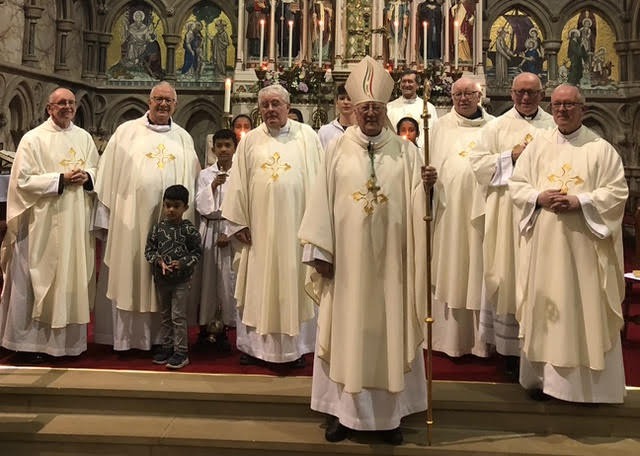
Whitby’s St Hilda’s Catholic Church was consecrated in 1925 and celebrated its centenary on 24th September 2025. The Bishop and Parish Priest celebrated the Thanksgiving Mass with many former clergy and parishioners past and present also in attendance.
St Hilda’s has been a feature of the Whitby landscape since construction first started in 1866. Through that period we have seen 15 serving Parish Priests, 13 Popes, two world wars and Whitby’s economy change from fishing, agriculture and jet, largely towards tourism. The church has played a key role in the community, such as supporting seafarers, the poor and elderly, as well as contributing to national and overseas charities. It is listed on most of the tourist websites as a “local attraction”, which ensures it gets a regular stream of visitors throughout the year.
Fr Sellers commented that: “The church building was Consecrated to God for Divine Worship in September 1925. This centenary celebration is a wonderful opportunity to thank God for the priests who built and cared for the building and for the people, as well as the countless blessings He has given to so many who have come here to pray. It is also a tribute to the strong faith of former generations who sacrificed themselves for the greater glory of God and the salvation of souls. We ask God to bless us and guide us as we rededicate ourselves to His service in our generation”.
History (see, also, the History page on this website)
After the upheaval of the Reformation in 16th century England, the parish church of Whitby St Mary the Virgin on the East Cliff, passed into the ownership of the Church of England. Gradually the town grew and more religious provision was made, but Catholicism remained illegal until 1788.
Around that period many Catholic clergy fled persecution in France, and some set up missions along the Yorkshire coast. One of these arrived in Whitby in 1803 and set about raising funds to build a permanent home for his community, by then around 150 strong. A small chapel holding 300 worshippers was opened on Walker Street behind the current church in 1805.
The opportunity came to buy the large plot of land of the current site and the then Parish Priest, Fr Glover, began serious fund raising from multi-benefactors. The structure took only about 18 months to build in 1866-7 but another 25 years to complete most of the decoration.
Consecration
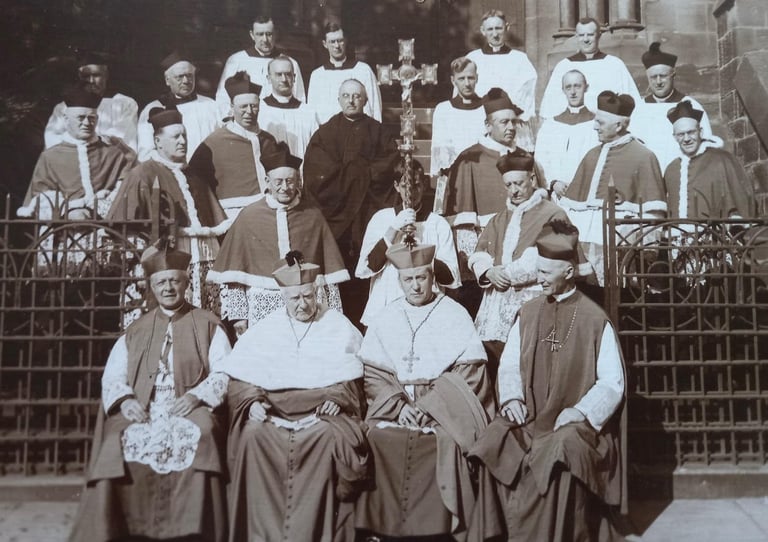
Consecration, when a church is given over to God, can only take place when it is completely free of any debt. This took place on 24th September 1925. The serving and auxiliary Bishops of Middlesbrough performed the ceremony in front of a great assembly of priests and clergy from the diocese and beyond. A report on the ceremony was included in the Whitby Gazette on 25th September 1925:
*****
The impressive ceremony commenced on the evening prior to the actual consecration, when the relics of the martyrs were deposited in the old chapel, now the club-room. Twelve crosses were graven on the walls inside the church, four upon either side, and two at the south end and in the chancel, a candle being placed before each of them, the candles being lighted the following morning. After this the Bishop caused the church to be closed, a deacon remaining within to keep the door. The consecration service commenced at 7.30am the next morning with the seven Penitential Psalms. The presence of the bishop was denoted by the hoisting of the Papal flag on a flagstaff in the Presbytery garden. The Bishop, in white vestments, went to the main door where litanies were sung. The procession then proceeded three times round the church, the Bishop sprinkling the walls with holy water and each time, on passing the still closed door, striking it with his crozier, the door being opened the third time. After a hymn the Bishop traced the letters of the Greek and Latin alphabets in two wide bands of ashes, which had been strewn from corner to corner of the nave, typifying the uniting of nations under the Cross. To enable this part of the ceremony to be performed, the whole of the seating of the nave had been removed. The Benediction was sung while the Bishop wrote. The interior walls were then sprinkled and blessed. After visiting and blessing the altar in preparation for the relics, he resorted to where they were deposited the previous evening. They were then carried round the church before being placed in the sepulchre of the altar stone. After anointing the altar and the crosses on the walls, appropriate prayers accompanying all the ceremony, incense was burned upon each of the five crosses on the altar slab, and while it was burning the prayer Come O holy Ghost fill the hearts of Thy Faithful was recited. The ceremony concluded with the solemn blessing of the altar cloths, crucifix, candlesticks, etc., and the Mass appointed for the dedication of a church celebrated.
*****
Church Design
The church is in the Early English Gothic style, designed by architect Matthew Hadfield of Sheffield and built from local Aislaby sandstone. Most of the principal contractors were Whitby-based parishioners, except for the slater who was from Scarborough.
The inside of the church is 101 feet at its longest, and 54 feet both high and wide. The tower was originally 148 feet high but was lowered by about 40 feet to reduce the weight after it was found to be moving away from the church. Apart from the main altar, there are altars dedicated to The Sacred Heart, Our Lady and the English Martyrs, and a wealth of stained glass windows and statues. Most of these were donated by parishioners over the years.
Our Patron St Hilda
Hilda, or Hild, was born in 614, the second daughter of the nephew of King Edwin of Northumbria. In about 647 she decided to enter religious life and, after various roles, she came to Whitby (then called Streonshalh) to found the abbey. She died in 680. There are two churches dedicated to St Hilda in Whitby, this one being the Catholic church in Victoria Square and the other is the Anglican church on West Cliff.
John Moran and Mark Edwards
Welcome
Explore our Mass times and parish history.
Contact
01947 602476
© 2025. All rights reserved.